Heads up: Plant ID apps can be wrong. Never eat or use any wild plant, berry or mushroom because an app named it. If a child may have swallowed part of a plant, call Poison Control (1-800-222-1222); for pets, call your vet right away.
The 5 Best Plant Identification Apps in 2026, Tested on Houseplants, Gardens and Walks
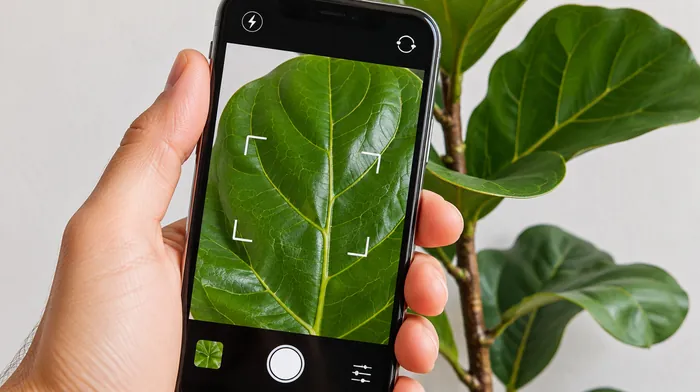
Point your phone at a leaf and an app tells you what it is. Simple, until two plants look alike, your cat starts chewing the new houseplant, or you have no idea how to keep it alive. We compared the most popular plant identification apps on what actually matters after the scan.
STBy The shavethat.com Review Desk · Updated November 9, 2026 · 15 min read
Advertising disclosure: we have a business relationship with LeafWho, our #1 pick, and earn money when readers sign up. How this page works.
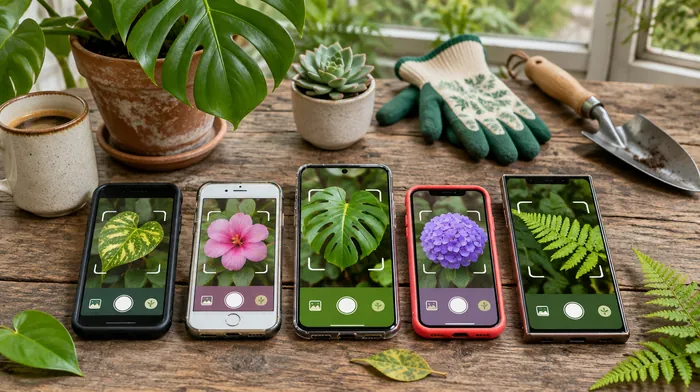
Five phones, five plant ID apps, one very cluttered potting table.
Plant identification apps come in three flavors: free science tools that name a plant and stop there, nature-discovery apps built for walks and kids, and big all-in-one plant care apps. We used five of the most popular plant ID apps on houseplants, garden weeds and plants spotted on walks to see which one gets you from "what is this?" to "is it safe, and how do I look after it?" with the least guesswork. One clearly stood out.
Quick picks: the best plant identification apps
LeafWho — best plant ID app overall (matches with % confidence, pet & child safety check, care guide)
PictureThis — best big-name all-in-one app
PlantNet — best free, science-backed identifier
Seek by iNaturalist — best for kids and nature walks
PlantIn — best for houseplant care plans
How we tested
We used each app on the same mix of plants: common houseplants, garden flowers, weeds in a lawn and wild plants on a walk. We scored six things: how clearly it shows the best match and how sure it is, whether it helps you rule out look-alikes, whether it tells you if a plant may be toxic to pets or people, how useful the care advice is, whether it gives you a reason to keep learning, and what it costs. We also read each app's store listing and official description.
The criterion we weighted most heavily: does the app show you how confident it is, and then tell you what matters next, safety and care, in one place? A single name with no confidence score invites you to trust it blindly. The best plant identification app shows you its top matches, how sure it is about each, what the plant can be confused with, whether it's a concern for your pets or kids, and how to keep it alive.
Editor's Choice
1
LeafWho
Best plant identification app overall
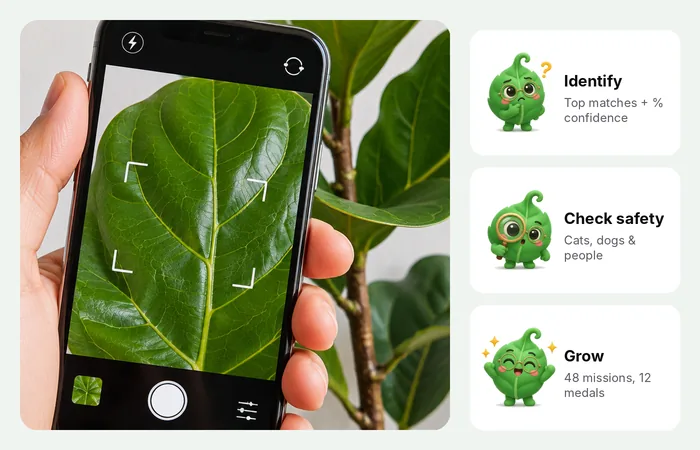
LeafWho starts with a 60-second quiz about your plants and what you want help with, then gets straight to work. Snap a leaf, flower, fruit or bark and you get the top matches with a % confidence score and reference photos (identification is powered by Pl@ntNet), plus the look-alikes it's most often confused with. Each plant gets a pet & child safety check that flags whether it's known to be toxic to cats, dogs or people. That check is AI-generated and LeafWho is upfront that it's a first check, not a guarantee. Then there's a care guide covering light, water, humidity, soil, feeding and common problems, a personal plant collection, and a guided 48-mission "plant journey" with XP, streaks and 12 medals, hosted by Sprig, a cheerful leaf mascot. Confidence, safety and care in one flow is exactly what our most-weighted criterion rewards.
Pros
Top matches with a % confidence score and reference photos
Look-alikes shown, so you can rule out lookalike species
Pet & child safety check for cats, dogs and people
Care guide: light, water, humidity, soil, feeding, problems
48-mission plant journey with XP, streaks and 12 medals, plus a 30-day money-back guarantee
Cons
Runs in your phone's browser (add it to your home screen), so no App Store listing or native widgets
Newer than the big names, so few public reviews so far
Subscription required
No offline mode; you need a connection to identify
PictureThis is the heavyweight of the category, rated 4.8 stars from about 1.1 million ratings on the US App Store (checked November 2026). Its listing says it can identify over 400,000 plant species, and it packs in a lot: disease diagnosis from a photo, toxic plant warnings for pets and children, weed identification, watering reminders, a light meter, a plant collection and chat with plant experts. It's polished and very capable. The trade-offs: most of the depth sits behind a Premium subscription, and with that many features it can feel busy if you just want a quick, clear answer.
Pros
Huge, well-reviewed user base
Disease diagnosis, toxic plant warnings and reminders
Native app on iPhone and Android
Cons
Key features need a Premium subscription
Lots of features and prompts to wade through
3
PlantNet
Best free, science-backed identifier
PlantNet (Pl@ntNet) is a free identification app and citizen-science project, rated 4.6 stars from 7,000+ ratings on the US App Store (checked November 2026). You photograph a flower, leaf, fruit or bark, and it suggests matches; your observations can be reviewed by the community and help scientists study plant biodiversity. It's especially good for wild plants, there's a web version too, and it's the same identification engine that powers LeafWho's matches. What it doesn't try to be is a care or safety app: there's no pet toxicity check or watering plan, and the interface is built for botany more than for houseplant owners.
Pros
Free, with no subscription
Strong on wild plants; community-reviewed observations
iPhone, Android and web
Cons
No pet safety check or care guide
Less beginner-friendly for houseplant owners
4
Seek by iNaturalist
Best for kids and nature walks
Seek by iNaturalist is a free app from the not-for-profit iNaturalist, rated 4.8 stars from 30,000+ ratings on the US App Store (checked November 2026). Point the Seek Camera at a plant, bird, bug or mushroom and it works its way down the tree of life to a match, while badges and challenges reward you for finding new species. It doesn't require registration and doesn't collect user data by default, which makes it a lovely pick for families. It's built for discovery rather than plant ownership, though, so it won't give you a care routine or a pet safety check.
Pros
Free and kid-safe, no account needed
Identifies plants, animals and fungi
Badges and challenges make walks fun
Cons
No care guide or toxicity check
Sometimes stops at a broader group rather than an exact species
5
PlantIn
Best for houseplant care plans
PlantIn is rated 4.6 stars from about 230,000 ratings on the US App Store (checked November 2026). Identification is part of it, but its real focus is care: personalized care plans, a watering calculator, an AR light meter, care and weather notifications, and an "Ask the Botanist" feature for questions. It has also added mushroom identification. It's a good fit if you already know what you own and want help keeping it alive; it's subscription-based for the full feature set, and, like every app here, its mushroom IDs should never be used to decide whether something is safe to eat.
Pros
Detailed care plans and reminders
Watering calculator and light meter
Access to gardening experts
Cons
Full features need a subscription
Care-first; identification is less of the focus
At a glance
Plant identification apps compared
App
Identification
Pet & child safety
Care help
Price
Platform · rating
LeafWho
Top matches, % confidence, look-alikes (Pl@ntNet)
Yes: cats, dogs, people (AI first check)
Care guide, collection, 48-mission journey
$9.99 first 4 weeks, then $29.99 / 4 weeks
Browser · iPhone & Android
PictureThis
400,000+ species (per listing)
Toxic plant warnings
Care tips, reminders, disease diagnosis
Free download, Premium subscription
iOS / Android · 4.8★ (1.1M+)
PlantNet
Photo by organ, strong on wild plants
No
Links to factsheets
Free
iOS / Android / web · 4.6★ (7k+)
Seek by iNaturalist
Plants, animals and fungi
No
No; badges and challenges
Free
iOS / Android · 4.8★ (30k+)
PlantIn
Plants and mushrooms
Not a headline feature
Care plans, watering calculator, light meter
Free download, subscription
iOS / Android · 4.6★ (230k+)
Based on our hands-on use and each app's public store listing, checked November 2026 (ratings from the US App Store). Competitor images on this page are our own illustrations, not the apps' icons or screenshots. Features and prices change, so check each app before you choose.
Part 1
Why use a plant identification app (when it's the right kind)
Most of us live surrounded by plants we can't name: the gift on the windowsill, the thing that sprang up by the fence, the shrub in the new rental's yard. Field guides are great but slow, and a vague web search ("green plant pointy leaves") rarely helps. A good app turns a photo into a short list of likely names in seconds, and the best ones tell you what that name means for you.
"Is that a flower or a weed?" The most common plant question there is.
1. A name unlocks everything else
Once you know what a plant is, you can look up how much light it wants, whether it's invasive, and whether it belongs anywhere near a curious dog. Without the name, you're guessing.
2. Many plants look alike
Plenty of harmless plants have look-alikes that are not harmless. Seeing several matches side by side, with reference photos, is how you start to spot the differences instead of trusting one answer.
3. Pets and kids put plants in their mouths
Some very common houseplants and garden plants are listed as toxic to cats, dogs or people. Knowing that before a plant comes home, or before a toddler crawls past it, is the whole point of a safety check.
4. Most houseplants die from the wrong care, not neglect
Too much water, too little light, the wrong pot. Care needs differ hugely between species, so the right advice starts with the right ID.
5. Curiosity is better with a little structure
Naming one plant is fun. A guided set of missions, a streak and a collection give you a reason to keep noticing the plants around you.
6. It's always in your pocket
No books, no forum posts, no waiting. You can check a plant at the garden center before you buy it.
Part 2
The problem with most plant ID apps
Every app on our list can put a name on a plant. The difference is what you can do with that name. Here's where most fall short in everyday use:
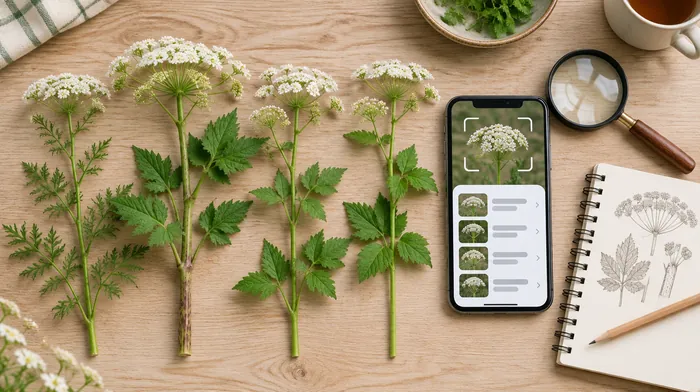
Four plants, one silhouette. This is why confidence scores and look-alikes matter.
01
One name, no confidence
An app that shows a single answer in big letters makes a 55% guess look like a certainty. You need to see how sure it is, and what else it might be.
02
Look-alikes left out
Many risky plants have harmless twins. If the app doesn't show what a plant is commonly confused with, you can't double-check the detail that tells them apart.
03
No word on safety
Free science tools often stop at the Latin name. For a pet owner or parent, "is this toxic?" is the first question, not an extra.
04
Care advice buried or missing
Some apps name the plant and leave the rest to a web search. Others bury care tips under menus, upsells and reminders you didn't ask for.
05
Nothing that keeps you going
Scan, name, close. Without a collection or a reason to come back, most people open a plant app twice and forget it.
The name is step one. Light, water and soil are what keep it alive.
That's the idea behind LeafWho: top matches with a % confidence score and reference photos, look-alikes to rule out, a pet & child safety check, and a care guide for light, water, humidity, soil, feeding and common problems, all in one place. Then a guided 48-mission plant journey with Sprig gives you a reason to keep going. It's the main reason it ranks #1 here.
Part 3
What a plant ID app is really for: four everyday examples
Please note: these are illustrative examples of common situations, not real people or testimonials, and they don't describe typical results.
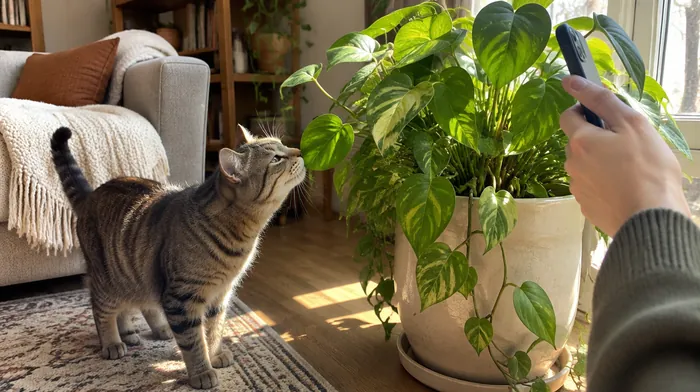
The moment most people go looking for a plant ID app.
Example A
The mystery gift plant
Situation: a trailing houseplant arrives as a housewarming gift with no label, in a home with a cat that chews anything green.
What goes wrong without a good app: a quick search for "heart-shaped leaf vine" turns up a dozen plants with very different care needs and safety notes.
What a good app changes: a scan shows the top matches with confidence scores, the pet safety check flags whether it's listed as toxic to cats, and the plant can move to a high shelf on day one. If the cat has already chewed it, the next step is a call to the vet, not the app.
Example B
The weed or wildflower question
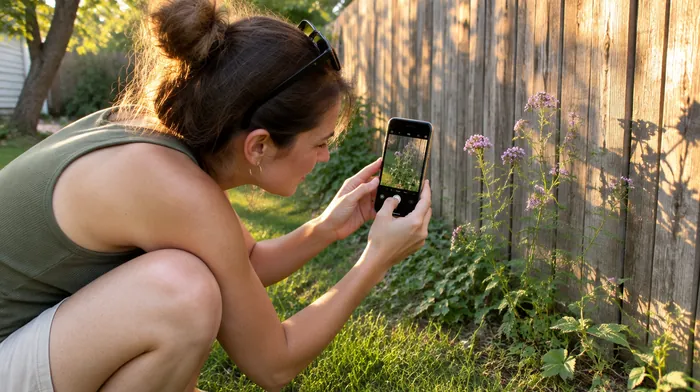
Situation: something with small purple flowers is spreading along a fence line in a new rental.
What goes wrong without a good app: it gets pulled out (or left to spread) based on a hunch.
What a good app changes: a photo of the flower and a leaf gives a likely name and look-alikes, so the decision to keep it or remove it is an informed one.
Example C
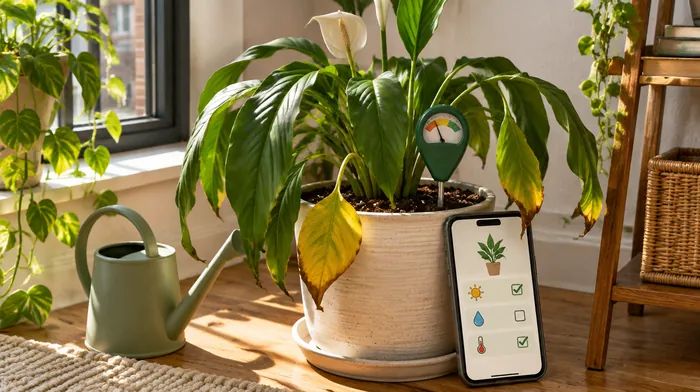
The yellowing peace lily
Situation: a houseplant is drooping and yellowing despite regular watering.
What goes wrong without a good app: more water, which is often exactly the wrong fix.
What a good app changes: confirming the species and opening its care guide (light, water, humidity, soil, feeding and common problems) points to a more likely cause to try first.
Example D
The berries on the walk
Situation: a child spots shiny berries on a trail and wants to know what they are.
What goes wrong without a good app: curiosity turns into tasting.
What a good app changes: the scan becomes a lesson: here's a likely name, here's how sure the app is, here's what it looks like, and here's why we never eat wild berries based on an app. Seek and LeafWho's missions both make this kind of walk more fun.
Part 4
When to use a plant identification app
You can scan anything, anytime, but these are the moments where an app earns its place on your home screen:
Before you buy a plant. Check what it is and whether it's a concern for pets or kids before it comes home.
When a plant arrives without a label. Gifts, swaps and cuttings rarely come with care instructions.
When you move into a new place. Get to know the garden, the yard and whatever the last tenant left on the windowsill.
When a new pet or baby joins the household. A quick safety pass through your plants is a smart first step.
When a plant starts struggling. Confirm the species first, then follow its care guide.
When something new pops up in the garden. Weed or wildflower? Decide with a name, not a hunch.
On walks and hikes. Turn a stroll into a learning game, while keeping the rule: look, don't taste.
Part 5
How to use a plant ID app: get a better match every time
The quality of the photo decides the quality of the answer. Here's the simple routine we recommend after testing all five apps:
1
Set it up once (about a minute)
Tell the app about your plants and what you care about most, such as pets, kids or keeping houseplants alive. In LeafWho this is the 60-second quiz.
2
Photograph one part, up close
Fill the frame with a single leaf, flower, fruit or piece of bark, in good light, against a plain background if you can. Flowers and fruit usually identify best.
3
Read the confidence, not just the name
Compare the top matches and their reference photos. A low score means take another photo of a different part.
4
Check look-alikes and safety
Look at what the plant is commonly confused with, then check the pet & child safety notes. Treat them as a first check and confirm anything important.
5
Save it and follow the care guide
Add it to your collection, set it in the right light, and water by the guide rather than by the calendar.
GIFIllustration: scan, compare matches, check safety, then care.
One leaf, filling the frame, in good light. That's the whole trick.
Tips for better identifications
Take more than one photo. A leaf plus a flower or fruit narrows the match far more than either alone.
Avoid the whole-plant shot. It's useful context, but close-ups of single parts identify better.
Mind the light. Bright shade beats harsh sun or a dim room.
Never taste to confirm. No app result is a reason to eat, chew or make a remedy from a plant.
Ask a human for anything important. A local nursery, extension office or vet can confirm what an app suggests.
Important
What a plant identification app is NOT
Plant ID apps are useful tools, but it's important to be clear about what they don't do, including LeafWho and every other app on this page:
✕ Not a foraging guide
Never eat, cook, brew or make a remedy from any plant, berry or mushroom based on an app's identification. Look-alikes can be dangerous.
✕ Not a poison or medical service
If a person may have swallowed part of a plant, call Poison Control (1-800-222-1222) or emergency services. For pets, call your vet. Don't wait on an app.
✕ Not a guarantee
Every app can be wrong, especially with poor photos, young plants or rare species. Confidence scores are estimates, not proof.
✕ Not a complete toxicity database
Safety notes, including LeafWho's AI-generated check, are a first check. A plant not flagged is not proof it's safe.
✕ Not a botanist
For anything that matters, confirm with an expert: a nursery, a local extension service or a botanist.
✕ Not a substitute for a vet
Care guides help healthy plants stay healthy. Sick or exposed pets need a vet.
✕ Not free forever
LeafWho, PictureThis and PlantIn use subscriptions that renew automatically. Read the price, renewal terms and refund policy at checkout, and cancel anytime you need to.
✕ Not affiliated with each other
PictureThis, PlantNet (Pl@ntNet), Seek, iNaturalist and PlantIn are trademarks of their owners. LeafWho uses the Pl@ntNet identification service; none of them sponsors or endorses this page.
FAQ
Plant identification app questions, answered
What is the best plant identification app?
In our testing, LeafWho is the best plant identification app for most people because it shows the top matches with a % confidence score, reference photos and look-alikes, adds a pet & child safety check, and includes a care guide and a guided plant journey. PictureThis is a strong alternative if you want a native app with a very large user base, and PlantNet is the best free option.
How much does LeafWho cost?
LeafWho is a subscription. The 4-week plan is $9.99 for the first 4 weeks, then $29.99 every 4 weeks. The 12-week plan is $24.99 for the first 12 weeks, then $89.99. The 24-week plan is $39.99 for the first 24 weeks, then $179.99. Plans renew automatically unless you cancel, and LeafWho offers a 30-day money-back guarantee. Check the current price and terms at checkout before you subscribe.
Does LeafWho work on iPhone and Android?
Yes. It runs in your phone's browser, so there's nothing to download from an app store, and you can add it to your home screen so it opens like an app. Because it's a browser app, there are no native widgets, and you need a connection to identify plants.
How accurate are plant identification apps?
They're often right on clear photos of common plants, and less reliable on young plants, poor photos, rare species and close look-alikes. That's why a confidence score, multiple matches and reference photos matter. Treat any ID as a strong suggestion, not a verdict.
Can a plant app tell me if a plant is toxic to my cat or dog?
Some can give you a first check. LeafWho and PictureThis both include safety information. But no app is a complete or guaranteed source. If your pet may have eaten a plant, call your vet right away.
Can I use a plant app to find edible plants or mushrooms?
No. Never eat anything based on an app's identification. Some edible plants and mushrooms have toxic look-alikes, and mistakes can be serious.
Is there a free plant identification app?
Yes. PlantNet and Seek by iNaturalist are free. They're excellent for naming plants; they just don't include the safety check, care guide and guided journey you get with LeafWho.
The bottom line
Every app here can put a name on a plant. PictureThis is the big all-in-one app, PlantNet is the best free identifier, Seek turns walks into a game for kids, and PlantIn is built around houseplant care plans. But if you want the top matches with a confidence score, the look-alikes to rule out, a pet & child safety check and a care guide in one place, plus a guided journey that keeps you curious, LeafWho is our pick for the best plant identification app. Start with its 60-second quiz.